


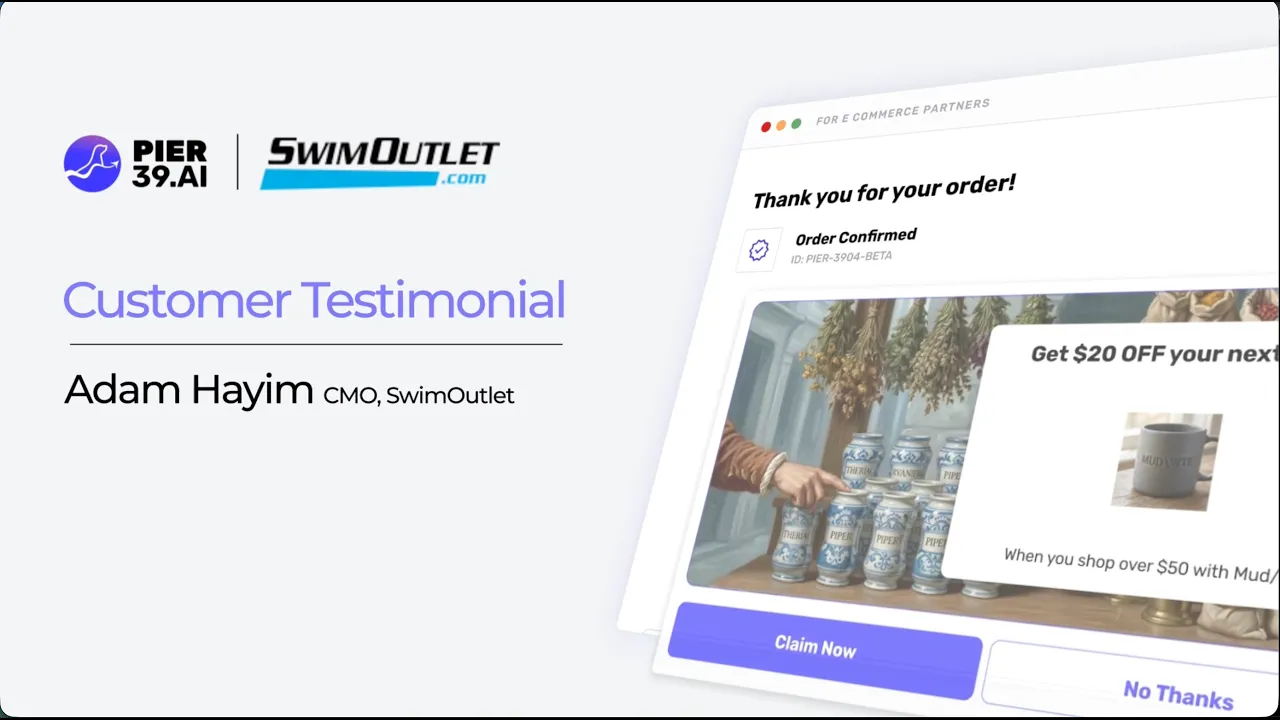

How SwimOutlet Grew Post Purchase Revenue Per Order 47% After Switching to Nash Post Purchase
Author
Ankita Verma
Published Date
March 14, 2026
Nash Post Purchase
Sporting Goods & Swimwear E-commerce
+47%
Revenue per transaction vs. Prior Provider
183.3%
Month over Month growth in #repeat-customers who redeem Pier39 coupons
100%
Port-over from the prior post-purchase provider
SwimOutlet, the largest online specialty retailer in aquatic sports, switched to Nash Post Purchase from Pier39 AI on Shopify Plus after buying out its prior provider's contract. Revenue per order rose 47% versus the previous provider, repeat customers redeeming coupons grew 183% month over month, and the account ported over at 100%.
About SwimOutlet
SwimOutlet is the largest online specialty retailers in aquatic sports, serving swimmers, triathletes, water polo players, and fitness enthusiasts across the US on Shopify Plus. What sets them apart is not product range. It is loyalty. Families have shopped with them for generations, and protecting that trust shapes every decision they make.
Our customers are swimmers - competitive, loyal, and not easily impressed. We've had families shopping with us for generations, and that's not something we take lightly. When your post-purchase experience is serving irrelevant offers, it quietly works against everything you've built. We made a change, and the results have been straightforward: revenue per transaction is up 47%, customers are coming back on store credits, and the experience finally feels like it belongs. For a business built on trust, that last part matters most.
Adam Hayim
VP Marketing & Growth, SwimOutlet
The Problem
SwimOutlet had been working with a post-purchase monetization vendor whose category fit made sense, but the execution fell short in two critical ways.
Slow, unresponsive support: Critical questions around reporting, offer configuration, or performance could sit unanswered for days. SwimOutlet moves fast and expects the same from partners. That lag was a problem.
Off-brand, generic offers: Customers who had just purchased a competition swimsuit or a pair of fins were being served generic, irrelevant promotions with no connection to swimming or to SwimOutlet. For a company built on generational loyalty, it was a missed revenue opportunity, but more importantly, an experience that was inconsistent with what their shoppers expect.
What SwimOutlet Was Looking For
SwimOutlet came in with four clear requirements.
Protect customer trust:
Multi-generational loyalty is not a marketing line for SwimOutlet. It is the business. The post-purchase experience had to protect it.
Native, relevant offers:
Offers needed to feel like a natural part of the experience, not an ad break.
Store credits that drive return visits:
They wanted a post-purchase moment that brought customers back to SwimOutlet, not somewhere else.
A responsive, transparent partner:
Fast responses, open data, no runaround.
How It Happened: Speed as a Signal
First call on a Thursday. Coffee and drinks the next day. SwimOutlet came with hard questions about reporting, offer quality, repeat purchase, and what transparency actually looked like in practice.
We answered all of them. By the end of that meeting, both sides knew they wanted to work together.
Initially, we explored a side-by-side comparison test because they were already working with another vendor.
However, due to Shopify platform limitations at the time, we could not implement a 50/50 split. Because of the transparency of our initial data and the strength of the partnership, they decided to move forward with a full 100% implementation, even buying out their existing prepayment contract to make the switch.
That says a great deal about the confidence level on both sides.
What We Deployed
We deployed our Autonomous Ad agent configured specifically for SwimOutlet’s brand and customer base.
A Note on Seasonality
We launched in late fall, historically a quiet stretch in competitive swim. Major buying cycles had not kicked in yet, and early repeat purchase rates reflected that. We were upfront about it with the SwimOutlet team from day one.
Then January hit. Swimmers returned to training, spring meet prep started, triathletes began their season build. Store credit redemptions ramped meaningfully. By February, repeat visits were trending strongly upward.
This arc validated something important: the store credit strategy is not a one-time revenue play. It is a compounding retention mechanism. The full value of the model is measured across a season, not a snapshot.
The January-February ramp gave us high confidence that the retention thesis is working exactly as designed, and that the long-term LTV impact will continue to grow as more customers move through full purchase cycles.
Key Metrics:
+47%
Revenue per transaction vs. Prior Provider
183.3%
Month over Month growth in #repeat-customers who redeem Pier39 coupons
100%
Port-over from the prior post-purchase provider
The 47% lift is the headline. The more important result is what sits behind it: a post-purchase experience SwimOutlet customers actually engage with, that sends them back to the store, and that does not put the brand at risk.
Strategic Takeaways
Watch the Interview
What's Next
The post-purchase flow is performing and the seasonal ramp is underway. Next, we are going deeper: smarter segmentation between casual and competitive swimmers, offer sets tied to SwimOutlet’s product calendar, and tighter optimization of store credit redemption rates. The 47% is a starting point.
Two ways Pier39 AI can grow revenue per order for your brand.
Nash Convert
Recovers margin in your store by engaging and converting stalling shoppers.
Nash Post Purchase
Adds another revenue stream for your brand and brings your shoppers back with advertiser-funded offers.
Checkout more Case Studies

How SwimOutlet increased their revenue per transaction by 47% with Pier39.ai

How Thigh Society unlocked Higher Revenue Per Transaction with Pier39.ai


How Partners Coffee Turned Post-Purchase Into a Consistent Revenue Channel